

We knew this was coming. In fact, it was before it even began. Before Raiders of the Lost Ark premiered in 1981, George Lucas and Paramount Pictures had already struck a deal for five movies. So, Indiana Jones was never envisioned to be just a trilogy, even if it took a staggering19 years for Round Four to follow suit. Round Five was set to happen. It was just, of course, a question of how soon. Harrison Ford wasn’t about to hang the fedora yet, but that was granted that the next caper wouldn’t take another 20 years. Father Time was catching up, obviously. And fast.
Well, thankfully, it did take less than two decades. By 2016, Disney had taken the reins and the fifth film was said to be due in three years. However, filming of 2017’s The Post and 2018’s Ready Player One put Steven Spielberg’s participation on hold, thus moving the target date to 2020. Several more rewrites (and a global pandemic) later, release was pushed back yet again.
It was only in 2021 when filming finally commenced. Luckily, Ford was still down – that, considering he was already 79 and had survived another plane crash six years before. It would mark his first lead role since 2020’s The Call of the Wild.
By then, Lucas and Spielberg had relinquished their respective mantles and taken on executive producer duties instead. Taking over the helm is director James Mangold, fresh from his Oscar-nominated turn in Ford V Ferrari. For this, he also co-wrote the screenplay with the Butterworth brothers, John-Henry and Jez, and David Koepp, who penned the predecessor. With the OGs no longer hands-on with the story, any disparity was bound to be felt. And, at 154 minutes, the longest in the series, it doesn’t always feel like an Indy movie.
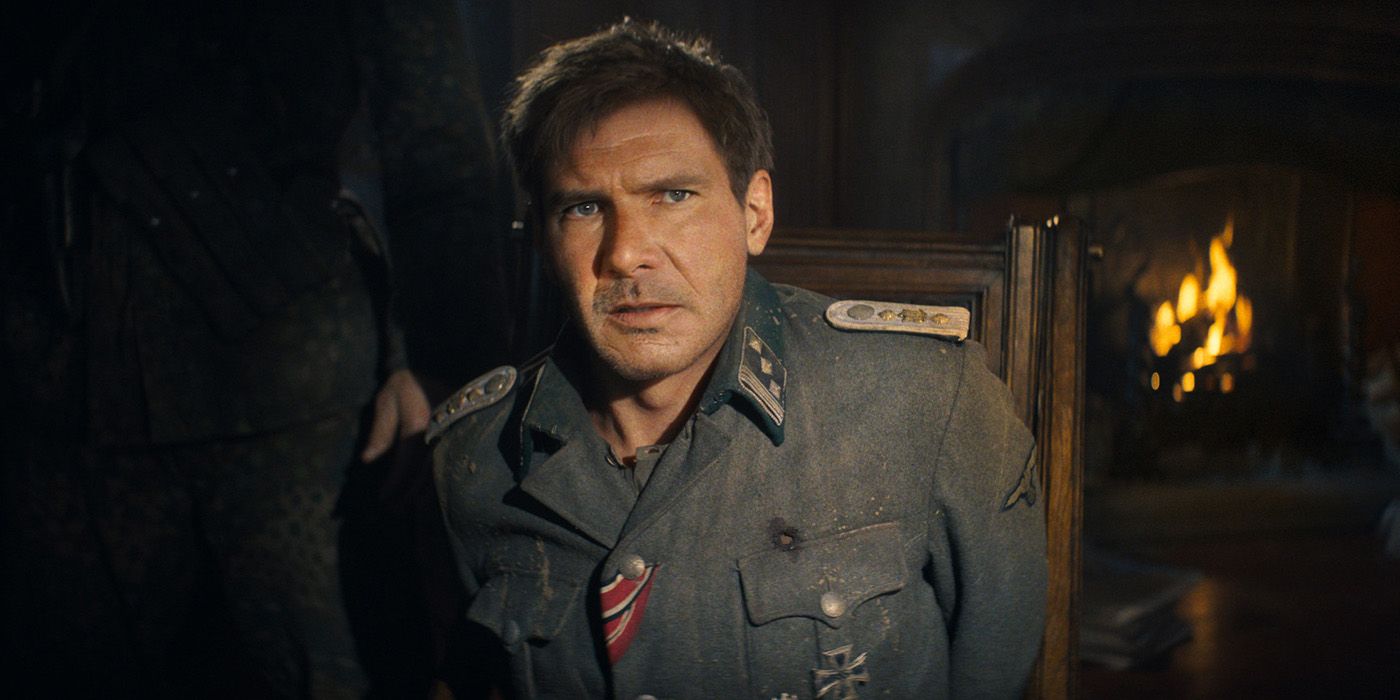
But it’s not to say that the spirit is fully lost. John Williams still does the score, after all, and this go-round still starts on a familiar note. The year is 1944 – six years after the events of The Last Crusade, and 15 before Kingdom of the Crystal Skull. We find Indy (a digitally de-aged Ford) venturing into the French Alps and once again crossing paths with the Nazis, his go-to arch-nemeses throughout half of the series. What follows is a high-octane train sequence, where he rescues his accomplice Basil Shaw (Toby Jones) and retrieves half of the Archimedes Dial, an artifact that, once complete, makes time travel possible. This riles up German astrophysicist Jürgen Voller (ever-menacing Mads Mikkelsen), who proves to be a potent villain throughout.
After that riveting 25-minute salvo, we fast forward to 1969, circa Apollo 11, hence the nods at David Bowie‘s Space Oddity. That’s where the main quest begins. We meet Indy, now elderly and dwelling alone in his New York City apartment. Notably missing is his only son Mutt, played by Shia Lebouf in the predecessor and then hinted as the heir apparent. The character’s absence is later explained. As for the actor’s, one can only surmise.

No matter. It’s fun seeing Indy in his twilight years, as an irascible old neighbor who can’t stand loud music and on the cusp of retirement from the academe. More so when we’re shown he’s still every inch that beloved adventurer. Adding spunk to this affair is English writer-actress, Phoebe Waller-Bridge, in her first major role since Fleabag. Here, she plays Basil’s daughter Helena Shaw, who inherited her dad’s obsession with the Dial. Logically, this puts her at odds with godfather Indy, who swears by its true dangers. This is also where Voller resurfaces. Now working with NASA undercover, he’s now more power-hungry than ever.
Framed for a crime he didn’t commit, Indy evades both Voller’s henchmen, including the ruthless Klaber (Boyd Holbrook) and the US authorities led by agent Mason (Guyanese-born actress Shaunette Renée Wilson) in yet another chase. Indy then turns to trusted colleague Sallah (returning mainstay John Rhys-Davies), who helps him flee to Tangier, to quell Helena’s shady dealings. This is where we meet her tween Moroccan sidekick, the intrepid Teddy Kumar (scene-stealing Ethann Isidore). Another chase sequence ensues, and the three later cross the Mediterranean. There, Indy reconnects with Renaldo (under-utilized Antonio Banderas), a skilled frogman, who helps them search for more clues underwater. It’s an all-too-quick sequence, and only serves to show that Indy’s ophidiophobia somehow extends to eels. Naturally, Voller and his posse soon catch up.
/cdn.vox-cdn.com/uploads/chorus_image/image/72435712/PLT_064800_R.0.jpg)
It all culminates in Sicily, where the story takes exciting, but also polarizing, turns. Just to give a hint, history – literally – repeats itself. As confusion takes over, the Lucas-Spielberg touch is sorely missed. The influence is there, but that only underscores what’s truly lacking. No bloated budget can fill that gap. And despite being the most expensive Indiana Jones movie ever made, it’s hardly a landmark.
Thankfully, it all returns to form by the epilogue, where our hero reconnects with the past, replete with homage to an iconic exchange. It’s a welcome touch of nostalgia, but also feels too little, too late. For a portrayal as legendary as Ford’s, a final cinematic hurrah is only fitting. Yet despite all the standout set pieces, memorable new characters, and that one playful final shot, this send-off ultimately doesn’t feel jubilant. It feels mandatory.

 Planet Chuckie