
“Athens welcomes the Universe, and Miss Universe welcomes you to Greece”
It was the first Miss Universe held in Greece, and for that matter, the first outside American soil. Before then, the first 20 editions had been staged in the United States – Long Beach, California from 1952 to 1959 and Miami Beach, Florida from 1960 to 1971. It was only their second year outside the mainland, first time being the previous year in Dorado, Puerto Rico. Territorially, that’s still USA.
So, 1964 winner Corrina Tsopei didn’t only speak for herself in the opening. In calling this edition “a dream come true”, she spoke, not just for her homeland, but for the whole Eastern Hemisphere as well. As the ceremonies kicked off on July 21, 1973, so did a pageant milestone.
Hosted by Bob Barker and Helen O’Connell, it was the first Miss Universe held in strictly European territory. And so far, it was also the last. Because, while Cyprus and Russia did host in 2000 and 2013, respectively, they’re both transcontinental countries by way of Asia.
By those accounts, it truly was a momentous edition – especially for Filipinos, who have much more sentimental reasons.
+++++++++
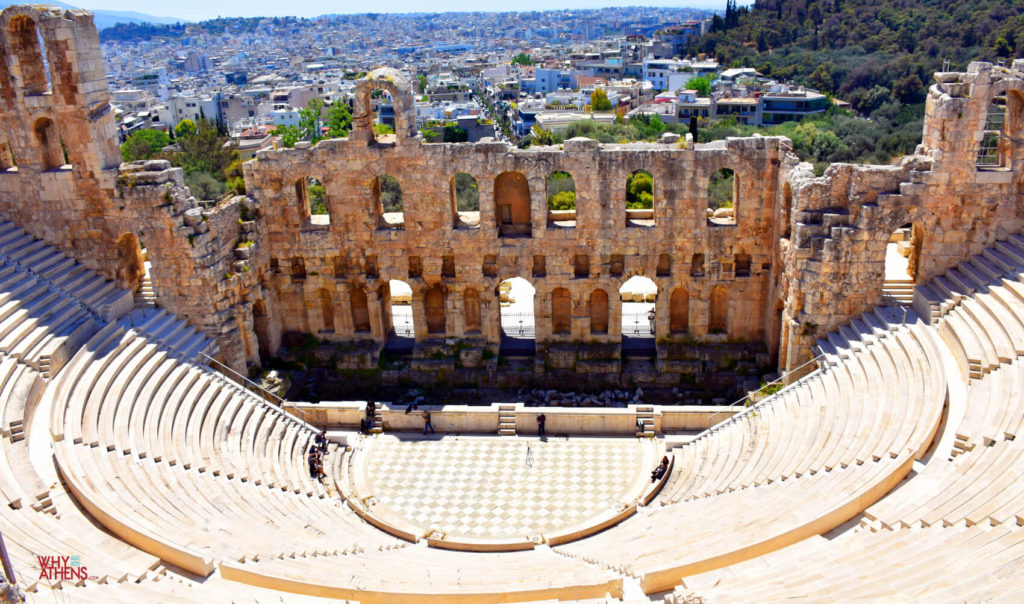
They couldn’t have picked a more storied venue. Situated at the foot of the Acropolis, The Odeon of Herodes Atticus was completed in A.D. 161 and destroyed a century later. It wasn’t until 1950 that the amphitheater was refurbished for modern use. It was, indeed, the perfect backdrop, as it encapsulated Athens’ history and aesthetics. Given the already striking façade, the structure barely required modification for the show. Though, imagine having to descend those cobble steps in heels. Somehow, those ladies managed. Since then, the venue had been used by the likes of Elton John, Yanni, Sting, Luciano Pavarotti, Liza Minelli, Diana Ross, and much more, recently, Florence + the Machine.
+++++++++
61 contestants competed that year, with the aforementioned Cyprus marking its debut and Sri Lanka curiously still competing as Ceylon, despite changing its name a year before. Among that roster, two countries are no longer active. Luxembourg sent its last candidate to date in 1994, while Hong Kong stopped sending candidates past 2000. England, Scotland, and Wales, on the other hand, now compete under one island – Great Britain.
It was a fairly competitive batch. A handful of non-placers either succeeded in other tilts or simply left lasting impressions, like New Zealand’s Pamela King (Miss World 1973 semi-finalist), England‘s Veronica Cross (Miss World 1973 finalist as Miss UK), France’s Isabelle Krumacker (Miss International 1975 semi-finalist), and Germany’s Dagmar Winkler (Miss International 1977 1st Runner-Up and Miss World 1977 2nd Runner-Up). Chile won its first Miss Amity (Congeniality) award thanks to Jeanette Robertson, a feat repeated 50 years later by Sofia Depassier, while Venezuela sent the overlooked stunner Desiree Rolando. Little did everybody know how unstoppable that country would become.
The Top 12 itself was a memorable field. From the South American mainstays, there were Brazil’s Sandra Ferreira and Colombia’s Ana Lucia Agudelo. Argentina, which performed considerably better in those years, sent eventual actress Susana Romero. Raising the flag for Greece was Sicta Papadaki, the first non-American host delegate to make the cut, and for Japan, Miyoko Sometani, who notably switched to a much shorter hairstyle for the finals. India’s Farzada Habib memorably demonstrated her palm-reading skills onstage. During that impromptu session, the mesmerizing beauty told Bob Barker that he would live a long life. As of this writing, he’s a few months shy of turning 100. Sadly, Lebanon’s Marcelle Herro didn’t live as long. She perished during her country’s civil war later that decade.
Israel sent a crown contender in Limor Schreibman. Unfortunately, the then-high school graduate deferred her final interview to request for an interpreter. When it was finally her turn again, she suddenly understood the question, much to Barker’s displeasure. Perhaps, that affected her chances as she settled for 4th Runner-Up.
3rd Runner-Up was Spain’s Maria del Rocio Martin, who also won Best National Costume; 2nd Runner-Up was Norway’s Aina Walle; and 1st Runner-Up was USA’s outspoken Illinois native Amanda Jones. Yet, as most would agree, one Maryknoller took the competition by storm: The Philippines’ Maria Margarita Moran.
+++++++++

Quiet as she seemed then, Margie was no underdog. Her father, Francis, was the son of former Chief Justice Manuel Moran. While her mother, Rosario, is the daughter of former president Manuel Roxas. Yet, she set foot on Athens just like any other international candidate. And her prospects grew brighter as days progressed.
Along the way, she also picked up the country’s second Miss Photogenic trophy. Not that it offered guarantees: Only two years before, the first Pinay to win that citation, Vida Doria, didn’t make the cut. Margie definitely needed more than the award.
Lucky for her, other factors were in her favor. She’d become one of the favorites, and no judge was more intrigued than Spain’s “El Cordobes”. After hearing her speak fluent Spanish, the famed bullfighter instantly listed Margie as a top pick.
Come finals night, breaking the Top 12 was a breeze. During her interview, she shared her background as a business administration student. That explained her love for counting money, and her ambition to put up a hotel. To which, the Bob Barker endearingly named her the future “Onassis of the Philippines”.
Though responses were more practical than profound, they revealed a grounded and assured young lady. Couple that with her composure and both the audience and the judges were sold. It took her solid presentations in both swimsuit and evening gown to seal the deal.
Call it a stroke of luck, but her Final Five question thematically echoed her Top 12 interview. When asked how she’d spend a million dollars, she instantly answered that she’d buy a house and lot simply because she couldn’t afford it that time. It was a straightforward answer to an equally straightforward question. And as far as the panel was concerned, that was enough.
And apparently, there’s truth behind that infamous eyeroll. While she didn’t outright see “Philippines” written on the envelope, a full name is obviously longer than an acronym (USA). So, that split-second glimpse was more than enough. Moments later, she became the second Pinay Miss Universe.
+++++++++

Her reign had its share of highlights and encounters, which included a guest spot on The Sonny and Cher Show and turning down an offer to pose for Salvador Dali, much to her everlasting regret. She was also the first non-American Miss Universe winner to crown her successor in her homeland. From then, she traded her crown with a multitude of hats.
Save for a 1974 movie bearing her name, Margie didn’t follow her compatriot Gloria Diaz’s footsteps. Showbiz wasn’t for her. Instead, she married Antonio R. Floirendo Jr., with whom she has two daughters, and pursued further studies in Boston University and the federal University of London. From 1989 to 1994, she developed and managed the Pearl Farm Beach Resort in her husband’s home province of Davao del Norte and, in 2001, she dabbled was producer of Marilou Diaz-Abaya’s Bagong Buwan.
In 2009, Margie touched base with her ballet background and led operations of Ballet Philippines for nine years. Soon after abdicating from that position, she was appointed chairperson of the Cultural Center of the Philippines, where she continues to serve to this day.
But to many a pageant fan, there will always be that fateful July evening. Yes, the country waited 42 years to recapture glory, but it was Margie who kept that path lit through those years. 50 years later, she continues to be living proof: that our achievements in pageantry are more than beginner’s luck.
 Planet Chuckie