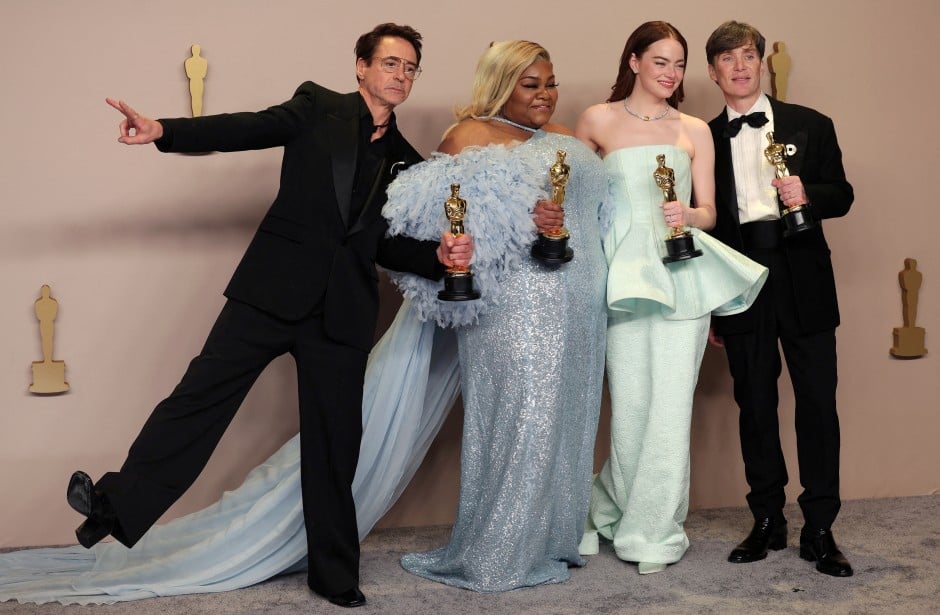
FOURTH TIME’S A CHARM. Jimmy Kimmel’s Oscars journey didn’t have the smoothest start. He was host when Warren Beatty and Faye Dunaway erroneously announced La La Land as Best Picture in 2017. He returned a year later, only for the Academy to decide to go host-less from 2019-2021. Well, his fourth outing (and second since returning last year) was his most solid yet. Even his flattest gags barely conjured cringes and his impromptu shoutout to Trump was a riot. But, as most would agree, it was his opening monologue which delivered the goods.
DA’VINE TIMING. From the get-go, the Best Supporting Actress award was always Da’vine Joy Randolph’s to lose. Nevertheless, that didn’t stop her from offering a tender moment or two. The Holdovers star was already in tears during Lupita Nyong’o’s introduction. Then came the inevitable victory speech, where she passionately shared this pondering: “For so long, I’ve always wanted to be different. And now, I’ve realized, I just need to be myself. And I thank you for seeing me.” Way to start the sprawling ceremony on an uplifting note, and moreover, it resonated with everyone who felt unseen.
USURPING SCRIBES. Much as the Bombmaker Biopic was foreseen to dominate, it was pleasantly surprising to see the Screenplay accolades handed to two other Best Picture nominees. First were the visibly elated Justine Triet and Arthur Harari who shared Original Screenplay honors for Anatomy of a Fall. Next was American Fiction writer-director Cord Jefferson, who won Best Adapted Screenplay for his take on Percival Everett’s 2001 novel Erasure.
JORTS ARE WORSE THAN NAKED. We knew we were up for a gag when Kimmel brought up the Streaker Incident from 50 years ago. So, there was more laughter than shock when John Cena took the stage almost completely nude, using the envelope to conceal his nether regions. Clearly, they were gunning for irony as he presented for Costume Design. The bit ended with Cena covered in drapes and Poor Things sweeping the aesthetic categories. Earlier, it had won for Make-Up and Production Design.
CALL FOR CEASEFIRE, PART 1. Neither Anatomy of the Fall nor Past Lives were their country’s respective entries in the International Feature Film race. So, that left UK’s The Zone of Interest as the odds-on pick. Somehow, the film’s subject matter should have dropped a hint. But, while the victory was expected, jaws still dropped when Jewish director Jonathan Grazer proceeded to boldly reveal his pro-ceasefire stance. Naturally, his speech sparked wild reactions and, unfortunately, several misquotes. Though, it was eventually made clear. He wasn’t denouncing his heritage, but rather, the usage of it to justify violence. Later in the evening, the film also went on to beat Oppenheimer in the Sound category – appropriate, since most of the film’s horrors were heard, not seen.
LIFE AFTER STARK. Obviously, no other acting nominee this year had a more fascinating rebirth than Robert Downey Jr. He stunned as the two-faced Lewis Strauss in Oppenheimer. Then, proving that Dolittle was just a mild post-MCU blip, he took this awards season by storm and swept the Best Supporting Actor category with ease. As he accepted his first Oscar, he showed no qualms referencing his sordid past. He began by thanking his “terrible childhood and the Academy, in that order”. After which, he proceeded in thanking his wife, whom he endearingly called his “veterinarian”. It was a predictable victory, but the speech exceeded expectations.
MR. FREEEZE AND PENGUIN REUNITED. Seeing Arnold Scharzenegger and Danny Devito as presenters was indeed a welcome throwback. How curious, though, that they downplayed 1988’s Twins and instead opted to emphasize the fact they both played Batman villains. Luckily, former Caped Crusader Michael Keaton was in on the joke – that cutaway was glorious. By the end of the bit, Best Visual Effects went to Godzilla Minus One, the first ever Oscar for the monster franchise, while Best Editing went to Oppenheimer, its second award that evening.
CALL FOR CEASEFIRE, PART 2. Sidesplitting as Kate McKinnon and America Ferreira’s dinosaur banter was, things understandably took a serious turn when 20 Days in Mariupol was announced Best Documentary Feature. Let this excerpt from director Mstylav Chernov’s speech speak for itself:
“This is the first Oscar in Ukrainian history. And I’m honored. But probably, I will be the first director on this stage who will say I wish I never made this film. I wish to be able to exchange this for Russia never attacking Ukraine, never attacking our cities…
But I cannot change history. I cannot change the past.”
WONDERFUL WES. Asteroid City couldn’t make a mark, but then, the Academy wasn’t always indifferent to Wes Anderson. Since 2001, he’d been earning nods for writing (The Royal Tenenbaums, Moonrise Kingdom), animation (Fantastic Mr. Fox, Isle of Dogs), and, once so far, in directing (The Grand Budapest Hotel). Little did we know it would take a Live Action Short Film to shift his fortunes. Despite muted fanfare, his take on Roald Dahl’s The Wonderful World of Henry Sugar earned him his first ever Oscar statuette. Now, if only he was around to relish the milestone.
IT’S A KEN’S WORLD AFTER ALL? We were never promised a Barbenheimer Rematch, and this isn’t just about Emily Blunt and Ryan Gosling’s on-stage truce (They’re also promoting a movie). Barbie entered the race with eight nods. That’s five less than its box office rival, Oppenheimer, which had 13. And with Margot Robbie and Greta Gerwig out of the Actress and Director race, respectively, its chances were considerably crippled. Then cue in the observant folk, who were quick to note how Gosling’s acting nod and Robbie’s snub contradicted the movie’s message. It’s an over-analysis, at best. But since we’re at the topic, it was the Kens who took the stage with Slash in that grand Gentlemen Prefer Blondes-inspired performance of Gosling’s nominated song, while they could only afford Robbie a cutaway. It’s like they really did give Ken the upper hand.
EMOTIONAL CORE. But really, Barbie’s one sure shot was Billie Eilish. The evocative “What Was I Made For?” dominated the awards season and bagged just about every plum it was up for – including the Grammy for Song of the Year. So, say what you want about the film’s overall loudness, it was the song which encapsulated what it wanted to say. Arguably, it’s even the heart of the film. With this feat, Eilish is no longer just the first Gen Z Oscar winner (Remember, she won for James Bond). Now, she’s the first Gen Z Oscar winner to win again.
TRICKY TRIBUTE. Andrea Bocelli was a timely choice to lead the In Memoriam segment (it’s his 30th year in music) and joining him in Sarah Brightman’s stead is his son Matteo. The father-and-son take on “Time to Say Goodbye” was indeed a poignant fit. But as with past executions of the tributes, not everyone was pleased. Punctuating the montage with a blink-or-miss list of names seemed like an easy fix. But to many, it felt like giving those departed icons the “Et Al” treatment. Case in point: Why relegate Cormac McCarthy, Treat Williams, and Suzanne Somers to that tier?
MISSED MILESTONE. Killers of the Flower Moon was never a major contender.But based on her strong start this season, Lily Gladstone felt like its best shot. And imagine the barriers it could have broken. Never before did a Native American enjoy such favorable odds in an acting category. It also would have been an extra olive branch, given how the Academy pilloried Sacheen Littlefeather in 1973. At least, they’ve apologized for that, and, least the performance of Best Song nominee Waxhexhe enjoyed quite a standing ovation early in the show. Alas, it was always a neck-and-neck battle between Gladstone and a previous Best Actress winner. And, in the end, voters opted to forego the risk.
This isn’t the first time a Martin Scorcese entry dominated the nomination tally, only to go home empty-handed – Gangs of New York and The Irishman endured as much. But knowing how this film missed a milestone probably by a hair, this one stings.
EMMA TAKES TWO. But then, how could anyone ignore Emma Stone’s tour-de-force act?As a modern-day Frankenstein’s monster, she brought utmost dedication to what could have earned other actresses a Razzie. Say what you want about the absurdity of it all, but it truly was her defining moment. And watching her second Best Actress speech in seven years, mid-wardrobe malfunction at that, it felt on-brand. With Stone’s victory, Yorgos Lanthimos’ Poor Things finished this year’s race second, with four wins.
ATOMIC GAZE. Many called it from the start, even with Paul Giamatti briefly seizing the momentum underway. The moment Cillian Murphy appeared on screen last year as J. Robert Oppenheimer and nailed the tug-of-war between accomplishment and guilt, it was bound to be his career-best. That gaze haunts, still. Frankly, it was even more explosive than his character’s invention. In his straightforward Best Actor speech, the Nolan mainstay thematically echoed the speeches of The Zone of Interest and 20 Days in Mariupol’s winners. “You know, we made a film about the man who created the atomic bomb and, for better or for worse, we’re all living in Oppenheimer’s world. So I’d really like to dedicate this to the peacemakers everywhere.” After which, he ended with the Irish thanks. Go raibh mile maith agaibh to you too, Mr. Murphy.
OVERDUE. It took a while for us to heal from 2011’s Inception snub. Besides, Dunkirk already took care of that six years ago. But then, during his long overdue acceptance speech, Christopher Nolan appeared to have taken all in stride and acknowledged that he’s only part of a bigger picture. “Movies are just a little bit over 100 years old. We don’t know where this incredible journey is going from here”, he began. Then he continued his grateful streak, saying “But to know that you think I’m a meaningful part of it means the world to me.” It was well worth the wait for the British-American filmmaker. Oppenheimer was the night’s biggest champion, winning seven out of its 13 nods. Nolan also ended the evening with his second Oscar, this time as one of its producers.
 Planet Chuckie