

At 75, Pedro Almodóvar just keeps outdoing himself, and to think he already managed to film Parallel Mothers at the thick of COVID-19. In late 2024, he released his first book, a short story anthology entitled “The Last Dream”. The collection consisted of 12 stories written in his youth, collected by his personal assistant, and compiled in what the auteur described as a “fragmentary autobiography”. It was the closest he ever came to writing his life story and, just like that, he had added “author” to his resume. But, the streak doesn’t end there. Not long before the book, he also scored a milestone in his day job. After 50 years as a filmmaker and 44 helming full features, he released his first English opus.
This adaptation of Sigrid Nunez‘s novel What Are You Going Through isn’t exactly a career height for the Spanish director. Arguably, 1999’s All About My Mother and 2002’s Talk to Her remain the standard. Linguistic switch aside, the trademarks are still prevalent, from the colorful frames to the humor-laced subtle drama, down to the relaxed storytelling and fixation with the mundane. The Room Next Door is still unmistakably and irrevocably Pedro, notwithstanding the absence of Penelope Cruz.
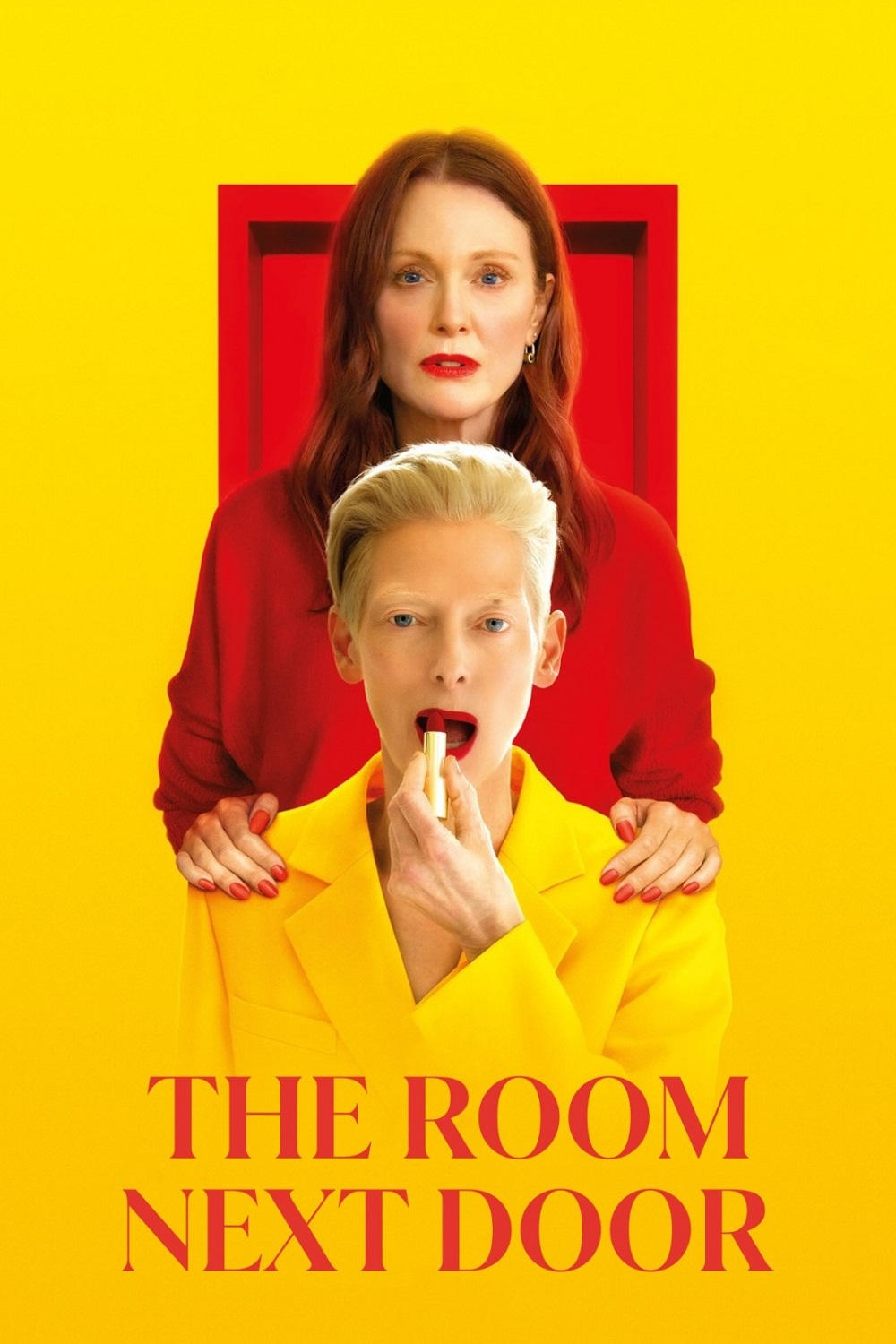
It’s no career-defining moment for its leads either. Prior to this, Tilda Swinton and Julianne Moore have tackled more compelling, trophy-luring roles in more hardcore dramas. Nevertheless, it’s a refreshing turn, if not a milestone detour.
This is, by far, one of Swinton’s most vulnerable performances. Here, she plays Martha, a successful author battling stage three cervical cancer. This prompts her colleague and fellow writer Ingrid (Moore) to cut her book-signing short and reconnect with her ailing friend. Much to the Ingrid’s surprise, Martha’s headstrong spirit remains, fueled perhaps by the hope that the experimental treatments would work. She may be withering, but her sharp sass is still intact. With her remaining strength, she recounts to Ingrid what life was like during their time apart. In the process, we learn about the fate of her ex-husband, Fred, and the existence of her estranged daughter, Michelle. More flashbacks commence, and we’re not sure how much of it is true. As Martha suspects, it could be the treatment talking. Her mind is muddled.

As the ordeal takes a grim turn and treatment options are maxed, that’s when it sinks in. We witness Martha’s anger, denial, and bargaining stages in one intense blow, as the film finally tackles its core theme of mortality. Unwilling to die suffering, Ingrid ponders on ceremoniously taking matters into her own hands. For that, she needs Ingrid, the only family she has left, to be nearby in her final hours. Though reluctant at first, Ingrid’s devotion prevails. She agrees to move in with Martha in her posh country home, where she’s asked to bunk in at the titular location.

The succeeding scenes show the bosom buddies sinking into more flashbacks and watching Buster Keaton DVDs. They, no doubt, relive and strengthen their bond through their shared interests, and some intriguing subtext is tossed in between. As they while away the hours, a foreboding ground rule is laid: that if Martha’s door is closed in the morning, it means she has departed. But count on Almodóvar to still execute those sequences in light-hearted fashion. Emotional outbursts, if any, are reduced to a pinch, but even that’s laced with humor.
More secrets unravel as Ingrid reconnects with former colleague Damian (John Turturro), whom Martha also knew. And the turn of events do rattle (enter Alessandro Nivola as an unnamed cop). But herein lies the beauty of this piece. We’re never made to obsess about finding answers, because no questions were even asked to begin with. The story stays transfixed on the connection, and not much else. So, even when a fragment of Martha’s past resurfaces later on, it feels non-consequential. It just appears – like a tiny detail in an artwork, we didn’t notice upon first glance. It’s always been Almódovar’s forte – the precedence of poetic storytelling over melodrama. And regardless of mother tongue, the language of his technique remains universal and understood by all. That makes The Room Next Door a more-than-worthy curiosity piece, if not game-changing opus.

 Planet Chuckie