

When it comes to commonly-tackled subjects, there’s always the question of what sets one apart. There was never a shortage of Bob Dylan films. In fact, they’ve been churning out documentaries since the start of his fabled career.
The earliest of which was D.A. Pennebaker’s Don’t Look Back (1967), which was set in Dylan’s 1965 England tour and famously ditched voiceover narrations in favor of plain backstage footage.
Martin Scorsese also tackled him twice this century – first in 2005’s biographical No Direction Home and, again, in 2019’s less orthodox Netflix release, Rolling Thunder Revue, which incorporated mock interviews and acting performances.
And speaking of which, Todd Haynes’ non-linear I’m Not There certainly defied convention in 2007. In lieu of featuring the folk legend, a group of superstars channeled different versions of him across different eras. Among that roster were Heath Ledger, in his final film appearance before his death, Christian Bale, Richard Gere, and Cate Blanchett, in her Oscar-nominated gender-bending turn. It remains the most off-beat Dylan story ever told, on any medium, to this day. Still, that didn’t stop James Mangold from taking on the challenge with A Complete Unknown.
Scorsese’s first attempt already concentrated on Dylan’s humbled beginnings to his controversial reinvention. Mangold, likewise, covers those bases, except, in his case, he took the dramatized approach, with “Going Electric” as his working title. The eventual title wasn’t conceived until further development. It’s easy to take as reference Dylan starting out as a nobody. But, really, it’s a line from “Like a Rolling Stone”, very much like Scorsese’s “No Direction Home” being an ode to the said song.

Timothée Chalamet had been the choice since Day One. In fact, the wunderkind spent most of the pandemic learning both guitar and harmonica to internalize his character. Behold, he more than just evokes the musician’s “cherubic look and mop of tousled hair”. He also uncannily nails the vocals.

The film begins with “Bobby” traveling to New York City to see his ailing idol, Woody Guthrie (Scoot McNairie), who’s too sick to even attend his own trial. There in his stead is his fellow singer-activist, Pete Seeger, brilliantly brought to life by Edward Norton. Seeger insists there’s nothing politically subversive with “This Land is Your Land”. Unsurprisingly, the case remains unresolved.
As Bobby arrives in the hospital, he finally meets both Seeger and Guthrie. That’s his cue to showcase his own composition, “A Song for Woody”. Impressed by his immense, raw talent, Seeger invites Bobby to spend the night at his home, and, subsequently, introduces him to his circle.

Over one fateful mic night, Bobby gets enamored with fellow singer Joan Baez, played beautifully by Monica Barbaro in a performance that had even the real Baez raving. Thus begins their flirtatious yet tension-filled dynamic. More importantly, Bobby’s performance catches the attention of record executive Albert Grossman (Dan Fogler). Suddenly, his self-titled debut album is underway, but with one major caveat. Save for his Woody tribute, he’s mandated to do mostly covers – much to his utter dismay.

As Bobby grapples with creative restraints and poor album sales, his rebellious side is amplified. This attracts Sylvie Russo, a fictionalized version of Dylan’s one-time flame Suze Rotolo, who appears on the cover of his second album, The Freewheelin’ Bob Dylan”. Here, she’s personified by Elle Fanning in a breathtaking portrayal. With Baez still present as Bobby’s constant collaborator, jealousy does come into play. Nevertheless, Sylvie continues to resurface throughout.
We do see Bobby reaching stardom, albeit still unfulfilled, especially with his label calling the creative shots. As his fifth album, Highway 61 Revisited, beckoned, so did his urge to experiment. Thus begins his infamous transition from acoustic to electric, much to the displeasure of purist folk fans. This concerns both his mentors and the organizers of the Newport Folk Festival, where he’s slated to perform. But being the iconoclast Bobby is, he still gets his way.
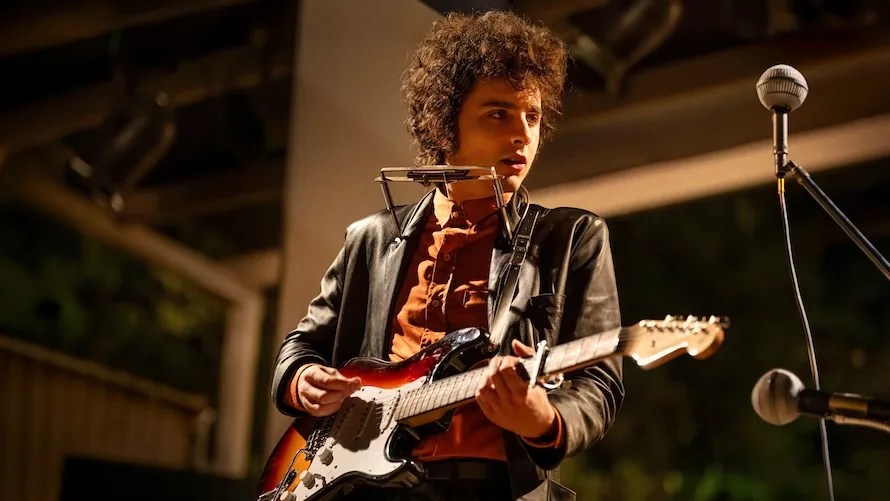
It becomes more exhilarating as Bobby boldly launches his new sound to a sea of jeering fans. Objects are thrown, yet there he still stands, determined to complete his set. And, of course, we hear some of the essential classics. Seeing Johnny Cash (Boyd Holbrook) in that sequence also feels full circle. Remember, Mangold did 2005’s “Walk the Line” about Cash and his wife June. Neither Joaquin Phoenix nor Reese Witherspoon were available to reprise their characters, not that it ever was a possibility. Still, what a throwback it must have been for the director.
By then, we witness Bobby’s tenacity at its peak, but that’s nothing die-hard fans don’t already know. And, to be blunt, the same can be said for this run-of-the-mill biopic, which hardly innovates. It’s the sincerity that still makes the ride worthwhile.
It’s been said that there’s no such thing as stories never told, only stories told in one’s unique way. It ultimately depends on the perspective and how well the story is conveyed. This one comes from the heart, and it has its overall commitment to thank as well. And as for Chalamet, no doubt, he’ll only continue to outdo himself.

 Planet Chuckie