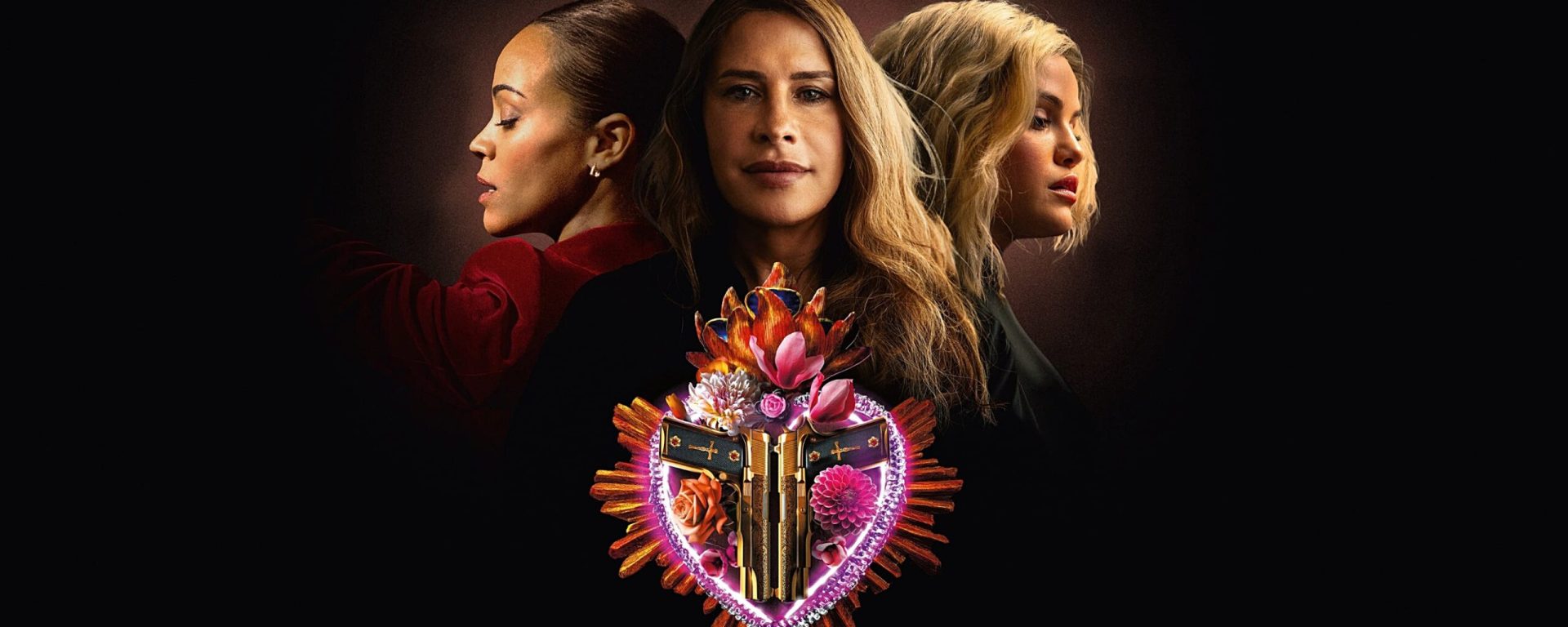

The praise was never universal from the get-go, notwithstanding the initial accolades and the fact it’s now the most Oscar-nominated non-English film in history. For one, it angered the trans community, the very group it wanted to champion, by depicting its main character in a devious light. Then, there’s also the uproar from Latin America. And it’s not just because the film is set in Mexico, but made by the French with a largely non-Mexican cast. Aggravating matters was when writer-director Jacques Audiard revealed he neither thoroughly studied Mexican culture nor the Spanish language before production. But that’s only surface level.
A deeper delve into the plot will make one understand, maybe even empathize with, the severe backlash. And, at 16%, it’s the lowest ever Rotten Tomatoes Audience Score for any awards season hopeful. Such is the peculiar case of Emilia Pérez, one of the most polarizing cinema pieces in recent memory.
Never before has a lauded film offended so many demographics, from ethnicities, professions, and especially, gender identities. And just when spectators thought it couldn’t get worse, a run-through of lead star Karla Sofia Gascon’s defunct Twitter (now X) account unearthed bigger monsters. Her past tweets reeked of bigotry and racism, with swipes at George Floyd and Muslim communities being the greatest offenders. Much as an apology was later provided, the actress has since been alienated, both by her colleagues and by the general public. It’s a flabbergasting fall from grace for Gascon, fresh from being the first transgender Best Actress Oscar nominee, and the film, which already had a spotty reputation to begin with.

It’s not to say this so-called trans-narco-musical is devoid of merits. After all, it was a hit in Cannes and there’s a reason Zoe Saldana is deemed as its saving grace. The film opens with her character, Rita Mora Castro, a hapless Mexico City attorney who’s perpetually at odds with her moral compass. But, the end justifies the means, so they say. So, she’s forced to whip up stories to win cases, even if her conscience beats her up for it.
The film sure doesn’t waste time bursting into song. Lest we forget, it was adapted from Audiard’s own four-act opera libretto, which he in turn lifted from Boris Razon’s novel Écoute. That accounts for the opening trial being set to “El Alegato” and Castro ruminating on her life choices to the tune of “Todo y Nada”. Not all pieces are exactly bops, but, of course, they’re crucial to the narrative.

By then, Rita’s introduced to Juan “Manitas” del Monte, a cartel leader who offers her an outrageous but lucrative deal. Haunted by his gender dysmorphia, the kingpin expresses intent to start anew as a woman. For that, he’d need to fake his death and send his family to Switzerland, despite initial resistance from his wife, Jessi (definitive turn by Selena Gomez). Suddenly, Mora Castro finds herself whisked to Bangkok and Tel Aviv to seek the best surgeon for the job. Cue the bizarre ditties “La Vagionplastia” and “Lady”, arguably the soundtrack’s most cringe-inducing cuts. Suddenly, the titular character is born and, four years later, she reunites with Rita in a well-mounted revelation scene.

Over their reunion in London, Emilia once again seeks help from Rita to reconnect with her family, under the pretense of being Manitas’ distant cousin. And, as they move back to Mexico and into Emilia’s posh home, that’s when things go full on telenovela. Jessi still believes she’s a widow, while one son (Juan Pablo Monterrubio) swears he can still smell his “Papa” in a heartfelt song number akin to a lullaby. But tender as that scene is, we’re not given much time to relish the transformation. Thus, it’s hard to buy the new persona, even when flashes of redemption start to manifest and even when she forms a connection with abused widow Epifania, played by Adriana Paz, the lone Mexican among the principal cast.
As for Rita, she still sees the perils of the world she had entered. That much she emphasizes in the electrifying number, “El Mal”. It’s conversely the best song in the film, next to “Mi Camino”, performed by Gomez.
The pseudo-family reunion is also not without complexities. Jessi re-encounters her ex-lover, Gustavo (Édgar Ramirez), who was once the third party in her past marriage. And when parenting inevitably becomes a point of dispute, we’re led to the riveting final act. That’s where the film finally takes a proper turn.

Priorities and secrets are revealed by the thrilling climax and, suddenly, lives hang in the balance. Rita shows up to intervene once again, which is enough to make us rethink Saldana’s Supporting Actress billing. This is, without a doubt, her career-defining role and she didn’t even have to paint herself blue or green. By the end, however, we still don’t know what to make of Emilia’s character. It’s one thing to purposely leave questions unanswered for an open-ended conclusion and another to just give up answering altogether. Even when Emilia’s celebrated, the transformation remains frustratingly unconvincing. It’s hard to tell if she sincerely reformed.
One cannot deny the film’s technical achievements and the efforts of its mostly game cast. It’s the mishandling of its subject matters that remains the deal breaker. Sensitivity’s still of the essence when tackling anything potentially ground-breaking. In that respect, this one shot itself on the foot before even taking strides. Nevertheless, the film is still bound to earn its share of accolades and remain a discussion piece. But will it eventually be a cult classic? That one’s harder to gauge at this point. Judging from the reactions, the wounds are still fresh.

 Planet Chuckie