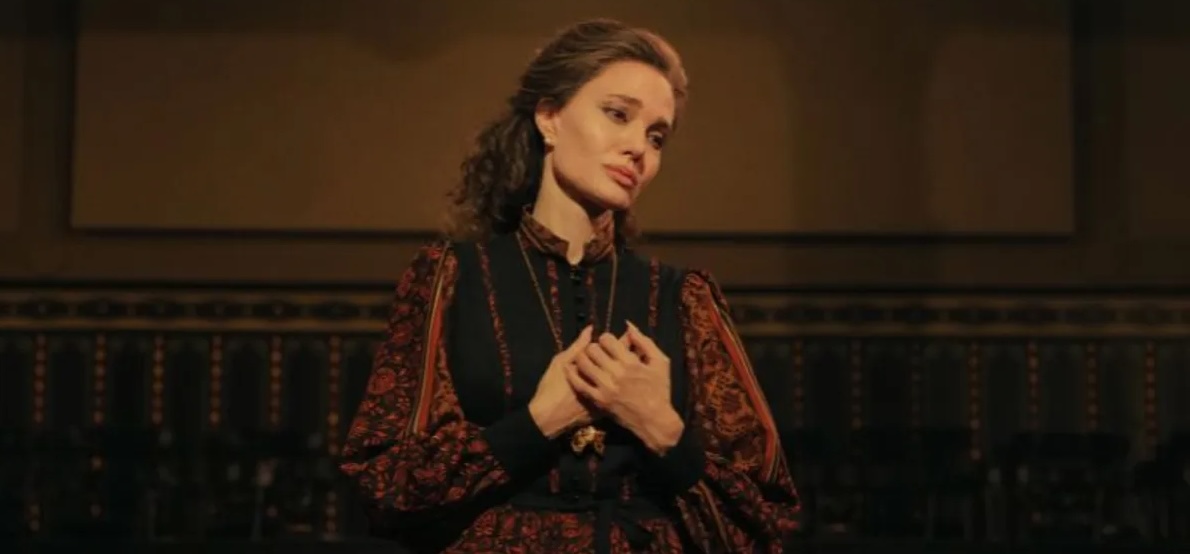

Maria Callas was 53 when she died in Paris. It was a sad end to the opera legend, whose career never fell short of mystery and intrigue. Even before then, she was already destined to become a myth. Yet, outside of plays and songs written in her honor, film tributes largely began only this century. Franco Zeffirelli was the first to dare, with 2002’s fictionalized Callas Forever. Then, in 2017 came Tom Volf’s critically-lauded documentary, Maria by Callas. It was the closest anyone ever got to an accurate story, seeing how it utilized actual archival footage and Callas’ own testimonies. Now, enter Chilean director Pablo Larraín with the eponymously-titled Maria.
It’s the third in what’s dubbed as Larraín’s “Lady With Heels” trilogy, a series of films focusing on female icons. First was 2016’s Jackie with Natalie Portman as Jacqueline Kennedy, followed by2021’s mostly-fictional Spencer with Kristen Stewart as Princess Diana. In this psychological biopic, Larrain teams up with writer Steven Knight again to depict the soprano superstar’s last seven days, as she grappled with her fading vocals and declining overall health.
Angelina Jolie was the only choice for the title role. Had she declined, the film never would have even existed. This marks her first lead billing since Taylor Sheridan’s Those Who Wish Me Dead and her first role since her underwhelming MCU stint in Chloe Zhao’s Eternals. Both films were released in 2021; so high time she graced the big screen again. And what a comeback: those are Jolie’s vocals heard throughout the film. This was made possible by seven grueling months of opera training, with some sessions even reportedly bringing her to tears.
The film opens with Callas’ death, a clear set-up to the story picking up in medias res, as they sink into that montage of her glory days. We then find her back in that posh apartment, still alive, trailed by her two poodles. She doesn’t exactly lack human companions. There’s her butler Ferrucci and housekeeper Bruna, played respectively by Pierfrancesco Favino and Alba Rohrwacher, who, on a piquant note, headlined the steamy 2010 Italian film, Cosa voglio di più (Come Undone). Obviously, this is a stark departure from that previous outing. Here, they’re (fully-clothed) doting servants, with Bruna routinely convincing Callas she’s still on-key and Ferrucci showing concern over her antidepressant intake. As Callas informs them that a TV crew is set to visit, the two can’t hide their bewilderment. Their lack of eye contact with the filmmaker (Kodi Smit-McPhee) already gives away the twist – more so, when he’s introduced as Mandrax, same name as Callas’ drug-of-choice.
Somehow, bits of Sunset Boulevard come to mind, as Callas wanders the streets mid-interview, pining for her heyday, and seeking all the validation she can find. The main difference is that she’s aware of the price of fame (“I took liberties all my life. And the world took liberties with me.”) and that she detests hearing her own recorded voice. Yet, she wants it all back just the same. This accounts for her regular sessions with conductor Jeffrey Tate (Stephen Ashfield) and why she imagines by-standers as her back-up singers. It’s all captured with a poet’s eye by cinematographer Edward Lachman.
This is curiously also Larrain’s second subject linked to Aristotle Onassis, a pattern yet to be fully explained, granted it’s not a coincidence. It’s widely known that the business magnate had a long-standing affair with Callas before marrying Kennedy. So, he’s bound to appear prominently here, mostly in flashback, care of Haluk Biliginer.
The rumination continues, as the film digs into her family history and amends are made. With Callas now more privy to her mortality, surrender becomes her remaining recourse. Yet, she still manages to use her strength to lash out at callous reporters. The film eventually reverts to where it began, where Callas uses her final breath in the very thing that gave her purpose. Apart from that, her actual point of departure isn’t portrayed over-dramatically or, for that matter, even over-staged. It just happens, and the confirmation is just bluntly delivered.
Whenever the plot centers on the subject’s fate, there’s hardly ever room for a grand reveal. It’s the ever-magnetic Jolie, however, who keeps viewers transfixed throughout even if we know where the road ends. It’s her committed, larger-than-life act that keeps the film on-key, even during its rare lulls. It’s another case of a performance being bigger than the story. Fortunately, the story doesn’t suffer much.

 Planet Chuckie