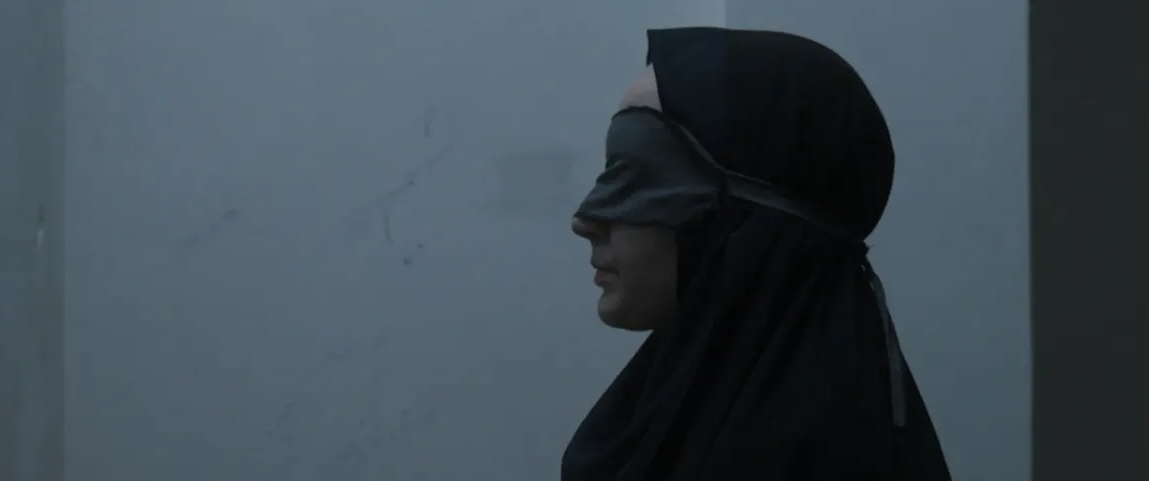

The opening Arabic text gives the lowdown on the metaphorical tree. In English, it goes:
“Ficus Religiosa is a tree with an unusual life cycle. It seeds, contained in bird droppings, fall on other trees. Aerial roots spring up and grow down to the floor. Then, the branches wrap around the host tree and strangle it.
Finally, the sacred fig stands on its own. ”
From there, it’s easy to gather as a dig at oppression, given director Mohammad Rasoulouf’s body of work and history of imprisonments. The Seed of the Sacred Fig, in fact, had to be filmed secretly for 70 days, with assistance from France and Germany, where the footage was edited. It’s such a harrowing journey for one subversive film, but not as harrowing as the events that inspired it.
Set in the thick of Iran’s anti-hijab protests, the film follows Iman (Missagh Zareh), a Tehran-based lawyer recently promoted to investigating judge at his job. It’s a lofty position, which promises an astronomical raise and an even larger home, but with a huge caveat. The sketchy conditions require him to approve death sentences even without prior assessment. In the process, he must remain anonymous to the public and keep his work secret to friends and family. Not even his unsuspecting teen daughters Rezvan (Mahsa Rostami) and Sana (Satareh Maleki) know exactly what he does for a living. His wife, Najmeh (Soheila Golestani), however, vaguely does, given also how she knows her husband and the fact that he was issued a handgun, despite not knowing how to use one. The risks, coupled with the escalating nationwide unrests, make Najmeh even more protective of her daughters, barring them from social media visibility and, all the more, socializing with their friends.
Those fears soon prove warranted when Najmeh ends up nursing Rezvan’s friend, Sadaf (Niousha Akashi), shot in the face during a protest before eventually being arrested. And with Iman’s identity suddenly leaked and his handgun missing at home, his occupation becomes harder to conceal. Riddled with paranoia, he then whisks his family away to his childhood home where his suspicions only further escalate. What follows then, is a galvanizing juxtaposition between women standing up for their rights and a family slowly on the decline. Although, somehow, it’s hard to understand how Iman would suddenly go Jack Torrance on his kin.
Whether taken as a commentary on misogyny or a condemnation of a stifling regime, the film doesn’t take the issues lightly. With phone clips of the actual protests interspersed with the story, more stomach-churning authenticity is provided, which makes Sacred Fig an even more gut-punching subversive experience.
 Planet Chuckie