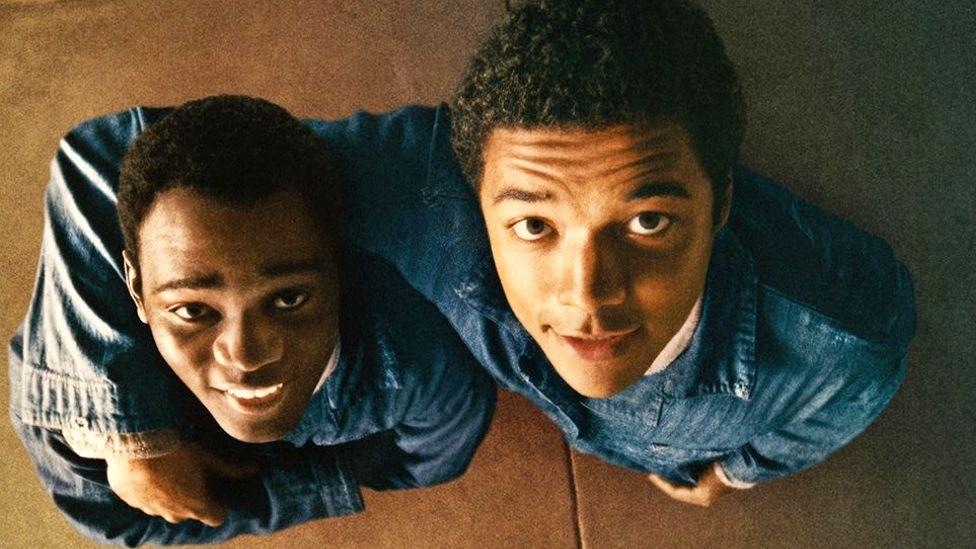

Colson Whitehead’s The Nickel Boys was, in effect, one of the last great reads from the Old Normal. Published in mid-2019, the book followed two African-American boys enrolled in Nickel Academy, a reform school based on the now-defunct Dozier School for Boys in Marianna, Florida. The pair form a tight friendship amidst the institution’s history of racial segregation and hidden abuse. But just like its true-to-life inspiration, the school’s secrets don’t stay kept.
Whitehead earned his second Pulitzer Prize for Fiction for this piece, following his first for 2017’s The Underground Railroad. It made him only the fourth author in history to earn the accolade more than once. Such was his novel’s lasting impact, an adaptation felt inexorable.
So, enter newbie director RaMell Ross, fresh from the success of his first documentary feature, Hale County This Morning, This Evening, when the book was released. Little did he know, that material would inspire his first narrative. By 2022, he was on board. For starters, “The” was dropped from the title.
It was Ross who visualized the film to be told completely in first-person or, in other words, through the protagonists’ point of view. Thus, we neither see the central character, Elwood (Ethan Herisse) onscreen during his formative years nor during the road mix-up which led him to the school in the first place. Instead, we either see hints of him through faint reflections or the reactions of the people around him. So, expect a lot of fourth wall breaks. And, to put it simply, pretend you’re the character.
Given the creative demands of that treatment, the script surely needed work-arounds. And, for that, Ross teamed up with Emmy-winning writer Joslyn Barnes. And, while we’re at it, props to Aunjanue Ellis-Taylor as long-suffering grandma Hattie, who singlehandedly raised Elwood, even with his Civil Rights Movement ties starting to worry her. It takes commitment to convey undying devotion and fortitude to a camera lens. To no surprise, she makes it credible.
Elwood’s idealism is tested when he finally enters the Academy. There, he’s quick to notice how the white students are treated better, while the blacks are subject to substandard conditions. Aggravating matters is Spencer (Hamish Linklater), the corrupt superintendent who convinces the colored folk that they can be released on good behavior, but not before subjecting them to unpaid labor. And that’s just scratching the surface.
It’s only when Elwood befriends fellow student Turner (Brandon Wilson) that he gains a new perspective. While Elwood subscribes to pacifism, Turner is much more skeptical. Yet, despite their conflicting views, their bond only strengthens. That’s when we finally start seeing Elwood onscreen. With the film now following two protagonists, the point of view now occasionally shifts to Turner, depending on the scene’s requirements. And, save for a mirror image shown later on (it’s what the poster uses), we never see both of them in the same frame, even when they exchange lines. Admittedly, it’s hard to buy their connection that way. That’s when the otherwise inventive technique shows its strain. Frustratingly, it happens when the plot thickens.
Yet, even the film trips on its ambitions, the story still manages to compel. There’s a reason the book was a hit, and it gets more riveting when the buddies ultimately choose to change their status quo. As the grisly truths slowly unravel years later, there’s a lot of intrigue to spare. Cue in Daveed Diggs, who finally unlocks the mysteries surrounding the duo’s fate and in, in a way, wraps up their story. The underlying battle, however, carries on, either when you’ve turned the last page of the source material or reached the adaptation’s end credits. Stories like this, after all, aren’t confined to their characters. They’re about the greater picture, obviously, and it’s far from quaint. This is the part where Nickel Boys excels. It neither spoon-feeds all of that nor does it, at any point, stock on melodrama. Instead, it emphasizes how it all starts with one’s point of view and builds up from the pockets of interaction as it goes along. Only then do we catch a wider glimpse. It doesn’t get more immersive than that.

 Planet Chuckie