
Again, the title is the scientist’s name, not the monster’s. And Mary Shelley never described the creation as a grunting behemoth with screws on its neck. That one was Boris Karloff’s take, immortalized through James Whale’s direction in 1931 and went on to appear in two sequels – 1935’s Bride and 1939’s Son. Since then, nearly every subsequent depiction picked up from that visual lead, from Herman Munster to Lurch.
But much as Universal Studios’ iteration was iconic in its own right, it was nowhere near the author’s depiction. Neither was Kenneth Branagh’s 1994 spin, who’s essentially Robert de Niro in stitches. The book version was much more grotesque, with translucent, yellowish skin, black lips, and a hulking eight-foot frame. It was as frightening as one’s mental imagery could allow, and no celluloid version could ever do justice. Well that certaintly didn’t stop Guillermo del Toro.
The Mexican auteur always wanted to take on the 1818 novel (subtitled “The Modern Prometheus”). In fact, the idea had been floating before The Shape of Water, and definitely before he reimagined Pinocchio as a Fascist Italian period tale. Given the critical success of his take on the puppet saga, he was bound to bend this one too. Reunited with him are cinematographer Dan Laustsen and composer Alexandre Desplat.
The creature was never meant to be evil, but, rather, a product thereof. It was simply a mish-mash of stolen corpses, sewn together, and given borrowed life. With almost no mental function, the monster’s left to fend for its’ self, seeking interaction and understanding, as opposed to harming with intent. Regardless of the ensuing chaos and body count, it was more pariah than serial killer. Dr. Victor Frankenstein was to blame for playing god, making his creation, in essence, the true victim.
Count on del Toro to mould the source into a new whole, just as the titular scientist reassembled body parts. The story now begins in medias res, with Frankenstein now given a back story. Here, we meet him as a boy, losing his mother after the birth of his younger brother, William, leaving him at the mercy of his distant stepfather (Charles Dance). That ignites his obsession with raising the dead, which he brings into adulthood.
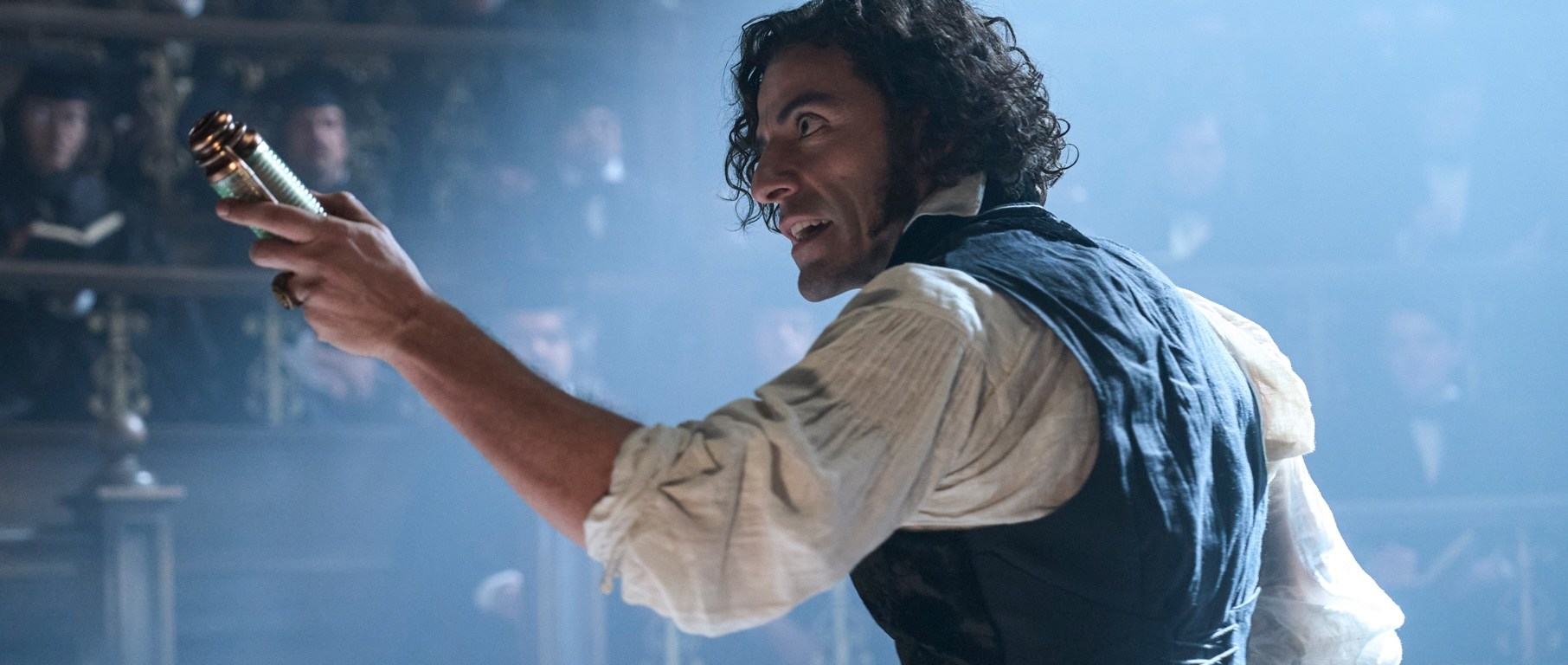
Enter Oscar Isaac as the adult Victor, who brilliantly oscillates between fragile and unhinged, and double Oscar champ Christoph Waltz, as his ailing financier, Henrich Harlander. In the process, we meet Harlander’s niece, Lady Elizabeth, who was Victor’s fiancée in the novel. Here, however, she’s engaged to grown-up William (Felix Kammerer), but Victor holds a torch for her just the same. And seeing how Mia Goth plays both Elizabeth and the Frankensteins’ ill-fated mother, an oedipal love triangle is implied but never fully fleshed out. The interpretation’s all up to the viewer.
Naturally, it all escalates when the creature comes to life and, no, Isaac doesn’t yell “It’s alive! It’s alive!” a la Colin Clive. Not on del Toro’s watch, just to emphasize once again, and, be forewarned, his version of that scene is…squelchier.
With his matinee charm, Jacob Elordi may seem like an offbeat choice. But his piercing eyes and 6’5 frame actually makes the Saltburn star a perfect fit – more so in this adaptation, where the character’s given a chilling twist. Eloquence and cognizance aren’t traits that come to mind when we think of the monster. Here, however, he doesn’t just absorb the turn of events, he also converses and, for a considerable portion, even narrates. That much unravels when he befriends the Blind Man (David Bradley, Pinocchio’s Gepetto), whose chapter takes a more tragic turn.
The pursuit soon intensifies, and so does Dr. Frankenstein’s hatred. This time, it goes well beyond monster-on-the-loose paranoia. His is just pure resentment, which soon starts echoing his own childhood trauma. Guess who’s the abusive “father figure” now?
As the story reverts to the North Pole, all subtlety is thrown out the window. And, how funny: To think tossing a girl into a lake already warranted censorship in 1931. It’s understandably all out now. Welcome to the 2020s.
But trust del Toro to let heart and soul prevail, no matter how weird or grim everything gets. He did Pan’s Labyrinth, after all, and who else could make sex with a merman credible? That’s always been among his strengths as a storyteller. And that’s showcased yet again here, when monster and maker (or should we say “father and son”) come face to face once more. Redemption is the operative word without giving too much away and the last word anyone would associate with this 207-year-old macabre classic. No one said del Toro had to keep the original ending, but in aiming to highlight the monster’s sensitivity, he tweaked what he had to tweak. News flash: he pulls it off.
 Planet Chuckie