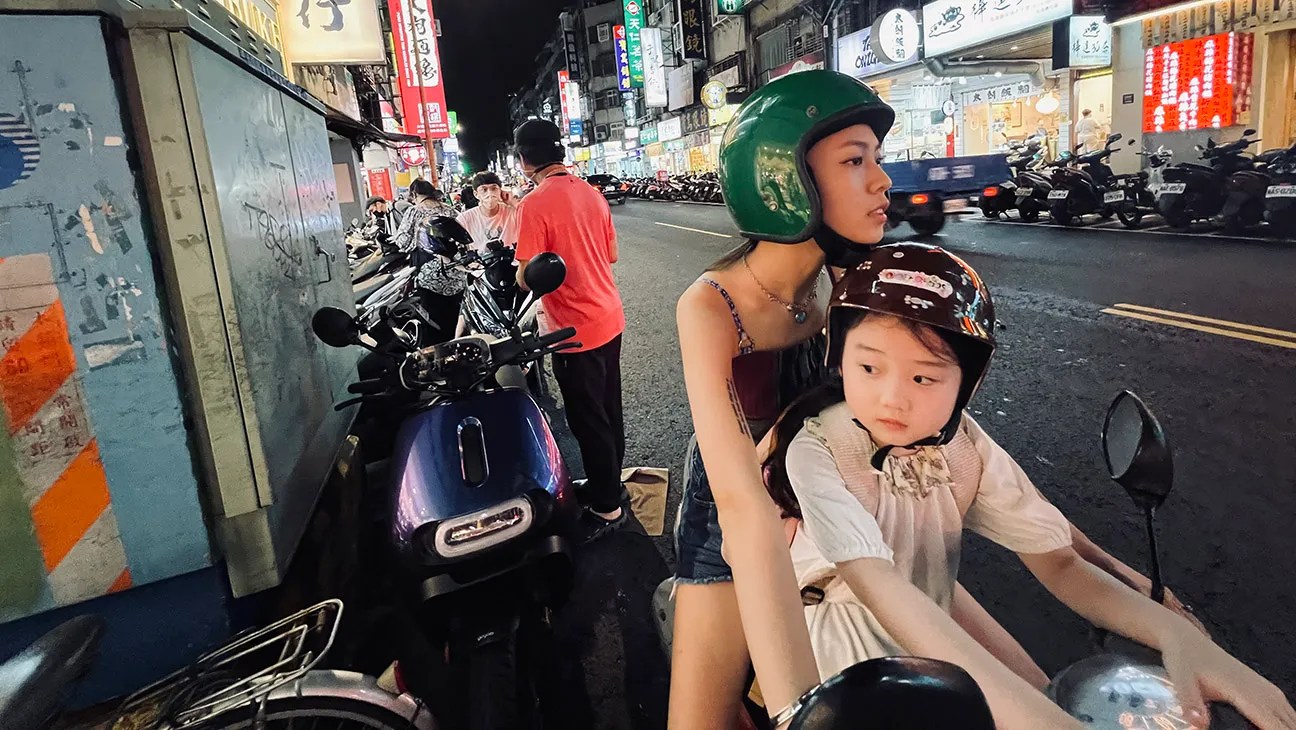

From the title, it’s clear whose vantage point we’re about to witness. Obviously, it’s that of I-Jing, the titular southpaw played adorably by Nina Ye, six at time of filming, 10 at time of release. In this poignant story, she’s whisked to Taipei with her older sister, I-Ann (Shih-Yuan Ma) upon their mother Shu Fen’s (Janel Tsai) resolve to start a new life. And with the opening kaleidoscope visual, another point’s made. Life is colorful in the eyes of a child, trials and tribulations be damned. In this family’s case, they’re financially in dire straits, hence, their relocation.
It’s as personal as it gets for Taiwanese-American filmmaker Shah-Ching Tsou, herself told as a child that being left-handed is demonic. That much is echoed here, with the grandfather (Akio Chen) also being the fear-monger.
Tsou wrote the script with constant collaborator Sean Baker in 2010, but it took 12 years for production to finally begin. Post-production couldn’t have wrapped up at the most opportune time, when Baker had just set records for Anora. In effect, consider this his follow-up, even if he’s here as writer-producer. It’s also a timely throwback to his “guerrilla” shooting roots. Just like 2015’s critically-lauded Tangerine, this film was shot with an iPhone.
There’s utmost delight seeing things unfold in I-Jing’s perspective. She may be naive, but she understands the hardships, especially with Shu Fen toiling at their noodle stand. When a meerkat incident makes her believe grandpa’s superstitions, she starts taking matters into her own hands, her “demonic” left, specifically. Meanwhile, I-Ann continues her rebellious streak.
The story seemingly deviates from focus, as I-Ann’s sordid tendencies re-emerge. But what feels like a dark subplot actually leads to the potent cathartic climax set in their grandmother’s (Xin-Yan Chao) 60th birthday. By then, the film seamlessly morphs from quasi-storybook fare (as in 2017’s The Florida Project) to a hard-hitting study of family tension and clashing beliefs (as in Anora, to an extent).
We don’t exactly get a happy ending. There hardly ever is, when generational trauma becomes the center piece. But as the Left-Handed Girl in question – rightfully – reclaims the spotlight, she manages to conjure smiles. Mind you, it’s not in a way that feels contrived, but in a manner that shows a kid being a kid. She’s the title character, after all. So, she rightfully wraps it all up.
 Planet Chuckie