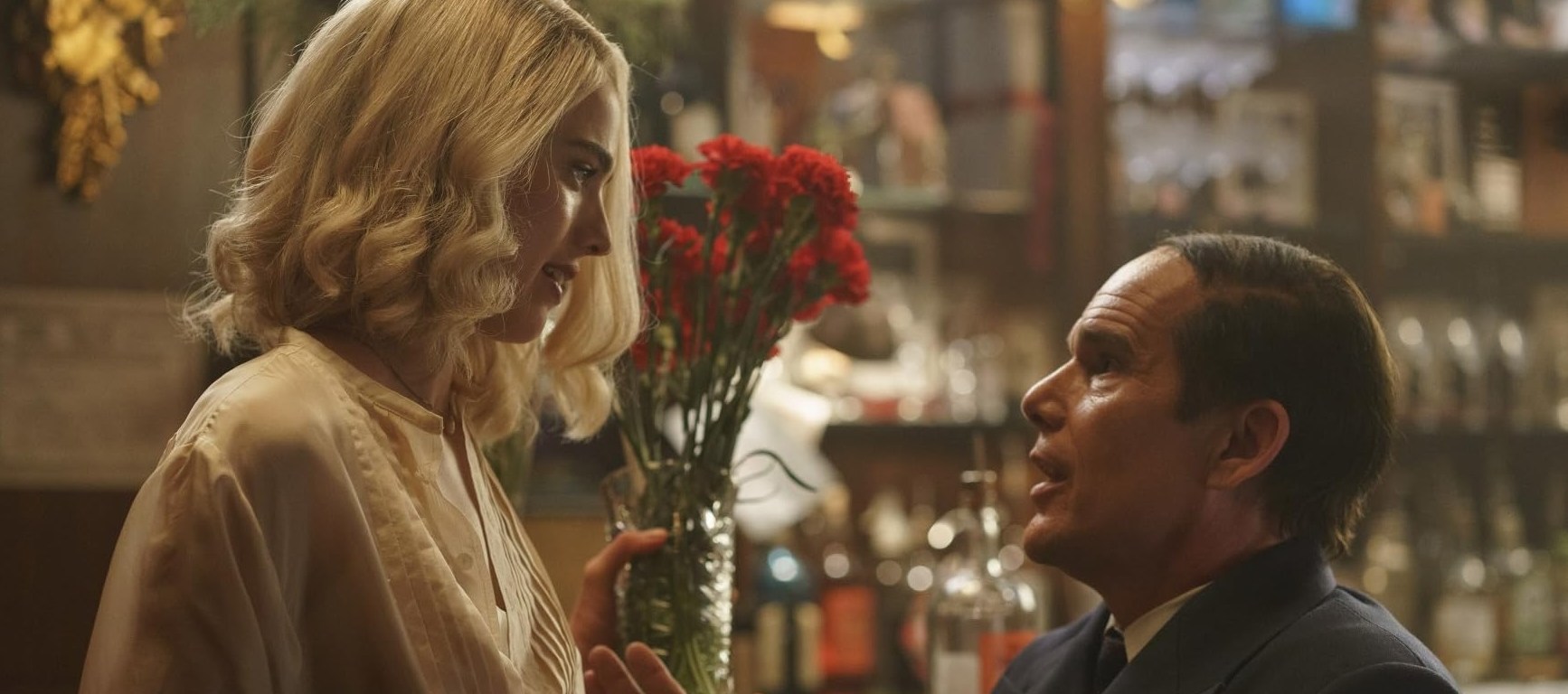

It’s no Richard Linklater essential, that much can be said. Some might even think it’s not by Linklater. But then, Ethan Hawke’s in it, which is arguably a dead giveaway. This could understatedly be a career-defining turn for the actor. And he neither had to spend a whole trilogy chasing star-crossed love nor age 12 years in a span of one production. Nonetheless, he flawlessly channels ill-fated American lyricist Lorenz Hart, who beefed up the Great American Songbook with then-collaborator Richard Rodgers. And, yes, one of those songs inspired the film’s title. But before we all start thanking movie magic for “aging” Hawke, here’s a fun fact. Hawke’s really seven years older than Hart was in the story.
Biopics need not be life-spanning chronicles, which is the point Blue Moon seemingly tries to raise. Save for that opening “flash-forward”, its entirety takes place at a restaurant, where most key events are referenced, and not depicted. Normally, that defies the cardinal cinematic rule of “show, don’t tell”, but screenwriter Robert Kaplow manages to keep things sharp, that one can’t help but eavesdrop. Call it payback, too, by the way. His debut novel, “Me and Orson Welles”, was adapted into film by Linklater in 2008.
The film’s set in 1943, when Casablanca was still the rage, hence the quotes, and Rodgers (Andrew Scott) had ditched Hart in favor of Oscar Hammerstein II. It was that very night when the duo’s debut piece, Oklahoma!, premiered. Instead of completing the play, Hart, sneaks out for a drink, with bartender Eddie (Bobby Canavale) and pianist Morty (Jonah Lees) on the receiving end of the trauma dump. Throughout the pity party, hints at Hart’s past transgressions are heavily implied, which explains the fallout. But the centerpiece would be his feelings for Elizabeth Weiland, his 20-year-old protege, played by a dazzling Margaret Qualley (who didn’t need to emerge from Demi Moore’s spine). In fact, the film’s purportedly inspired by letters between the two.
Love or hate the simplistic low-key treatment, it’s an interesting experiment from Linklater, a director known for pushing boundaries. Here, he deliberately the trappings of An American in Paris and La La Land and churns out a music biopic that invests on as much subtext as soundtrack. It’s a worthy sound trip, even without the spectacle.
 Planet Chuckie